
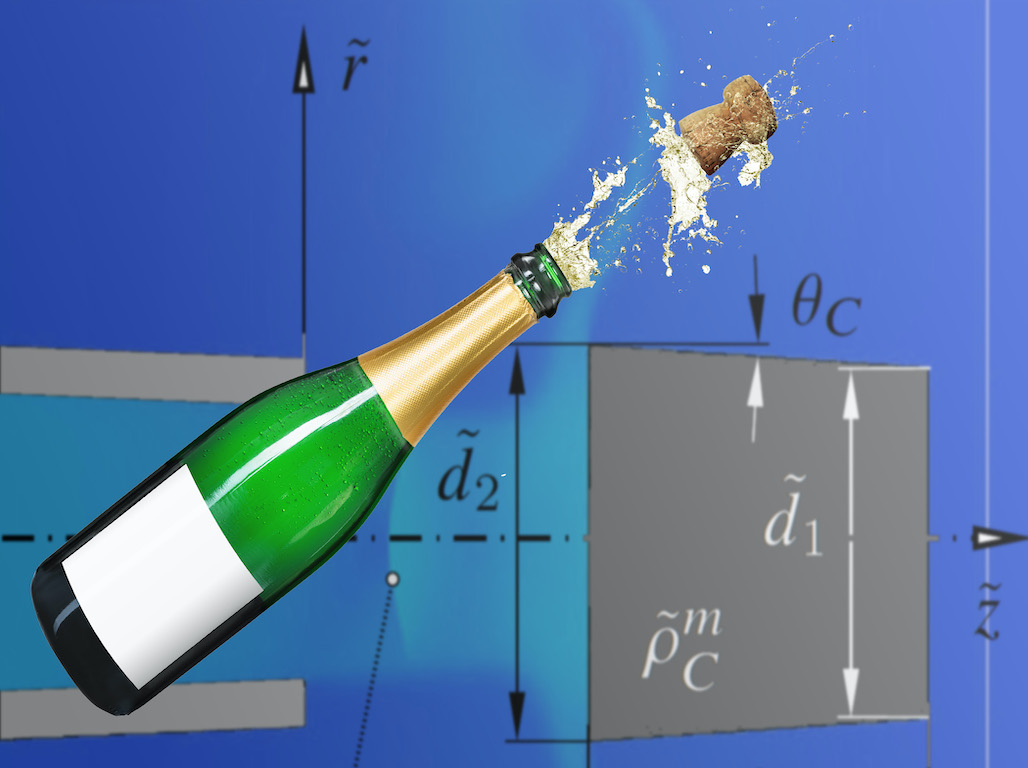
December 2023 | What happens when you uncork a bottle of champagne? Amazing phenomena occur: A supersonic shock wave forms and the gas flow can reach more than one and a half times the speed of sound.
It sounds like a simple, familiar everyday phenomenon: there is high pressure in a champagne bottle, the cork is pushed outwards by the compressed gas in the bottle and flies away with a powerful bang. But the physics behind this is complicated. Three scientists at TU Wien have now been able to calculate exactly what happens during this process for the first time. The results are also important for other applications involving gas flows around ballistic missiles, projectiles or rockets.

Discovered the physics of champagne cork: Stefan Braun, Lukas Wagner, Bernhard Scheichl (from left to right)
The pop when the bottle is opened is a combination of different effects: The cork expands abruptly, creating a pressure wave, and you can hear the shock wave, generated by the supersonic gas jet. Experiments with high-speed cameras have already been carried out, but a mathematical-numerical analysis was missing. This gap has now been closed at TU Wien. With the help of complex computer simulations, it was possible to recalculate the behaviour of the stopper and the gas flow.
“The champagne cork itself flies away at a comparatively low speed, reaching perhaps 20 metres per second,” says Lukas Wagner, the first author of the study, who is a doctoral student at TU Wien and also conducts research at AC2T. “However, the gas that flows out of the bottle is much faster,” says Wagner. “It overtakes the cork, flows past it and reaches speeds of up to 400 metres per second.”
This speed exceeds the speed of sound.
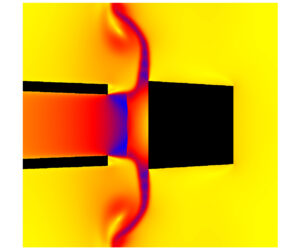
The cork has left the bottle, a shock wave forms
The gas jet breaks through the sound barrier shortly after the bottle is opened, accompanied by a shock wave. When a shock wave occurs, there are discontinuities in variables such as pressure and velocity, known as a “Mach disc”. This phenomenon is also observed in supersonic aeroplanes or rockets.
When gas expands, the temperature changes abruptly. This effect is very pronounced in the champagne bottle: the gas can cool down to -130° C at certain points. The CO2 that makes the sparkling wine bubble can even form tiny dry ice crystals.
“The fact that supersonic phenomena actually occur when a bottle of sparkling wine pops was anything but clear at first – you wouldn’t necessarily expect it,” says Bernhard Scheichl, Lukas Wagner’s dissertation supervisor. “But our simulations show that this arises quite naturally from the equations of fluid mechanics, and our results agree very well with the experiments.”
Original publication:
Lukas Wagner, Stefan Braun & Bernhard Scheichl (2023): Simulating the opening of a champagne bottle. Accepted in: Flow (2023), 3 E40, doi:10.1017/flo.2023.34,
free accessible version: https://arxiv.org/abs/2312.12271