Amorphous metals are twice as strong as steel, yet significantly lighter and more elastic. They exhibit isotropic behaviour, which means their material properties remain identical, regardless of the direction in which the 3D printer builds up the workpiece. In addition to creating highly robust parts, 3D printing also gives engineers more freedom in the design process. A number of areas could benefit from 3D printing of amorphous metals. Key examples include parts that are subject to significant stresses and lightweight design in sectors such as aerospace and mechanical engineering. These materials are also an excellent choice for medical devices due to their biocompatibility.
3D printing opens up new applications for amorphous metals
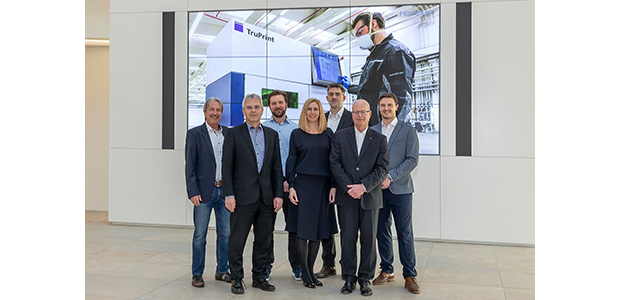
“3D printing of amorphous components in industry is still in its infancy. This new collaboration will help us speed up printing processes and improve surface quality, ultimately cutting costs for customers. This will make the technology more suitable for a wider range of applications, some of which will be completely new,” says Jürgen Wachter, head of the Heraeus Amloy business unit.
“Amorphous metals hold potential for numerous industries. For example, they can be used in medical devices – one of the most important industries for Additive Manufacturing. That’s why we believe this collaboration is such a great opportunity to make even more inroads into this key market with our industrial 3D printing systems,” says Klaus Parey, managing director Trumpf Additive Manufacturing.
Amorphous metals are formed by cooling molten metal extremely quickly. A 3D printer can then build them into larger, more complex parts – something that other methods are unable to do. This opens the door to new industrial applications for amorphous metals. 3D printing also exploits the considerable potential that amorphous metals hold for lightweight design. A 3D printer only builds structures that actually help a part fulfil its function, so material use and weight are kept to a minimum. For their part, amorphous metals are very light by nature, so the combination of 3D printing and amorphous metals can reduce weight in all sorts of applications. 3D printing makes the production of amorphous parts faster and simpler in a wide range of contexts. The technology enables users to build parts in one piece instead of making components one by one and then assembling them into a finished part.
Optimised material + adapted 3D printer
In this cooperation, Heraeus Amloy combines its expertise in the production and processing of amorphous metals with Trumpf’s experience in Additive Manufacturing. Heraeus Amloy has optimised its amorphous alloys for 3D printing and tailored the material for use with Trumpf’s TruPrint systems. The latest-generation TruPrint 2000 machine is a particularly good choice for printing amorphous metals. The machine is designed in such a way that the excess powder can be prepared in an inert gas environment for the subsequent building process. This protects the powder from any adverse influences. This is a key benefit for amorphous metals because they react so quickly with oxygen. Trumpf has also boosted the productivity of the TruPrint 2000. Two 300-watt lasers scan the machine’s entire build chamber in parallel. Using a laser focal diameter of just 55 micrometers, users can carry out both low and high-volume production of amorphous parts with extremely high surface quality. The “Melt Pool Monitoring” function automatically monitors the quality of the melt pool, so any errors in the process are spotted at an early stage.
Customers can already order amorphous parts or print them themselves
Customers that already have a Trumpf 3D printer can now use it to process zirconium-based alloys from Heraeus Amloy. It is also possible to order 3D-printed amorphous parts directly from Heraeus Amloy. The two partners are also hoping to make copper- and titanium-based alloys available for 3D printing in the future.
(Source: Trumpf Additive Manufacturing)