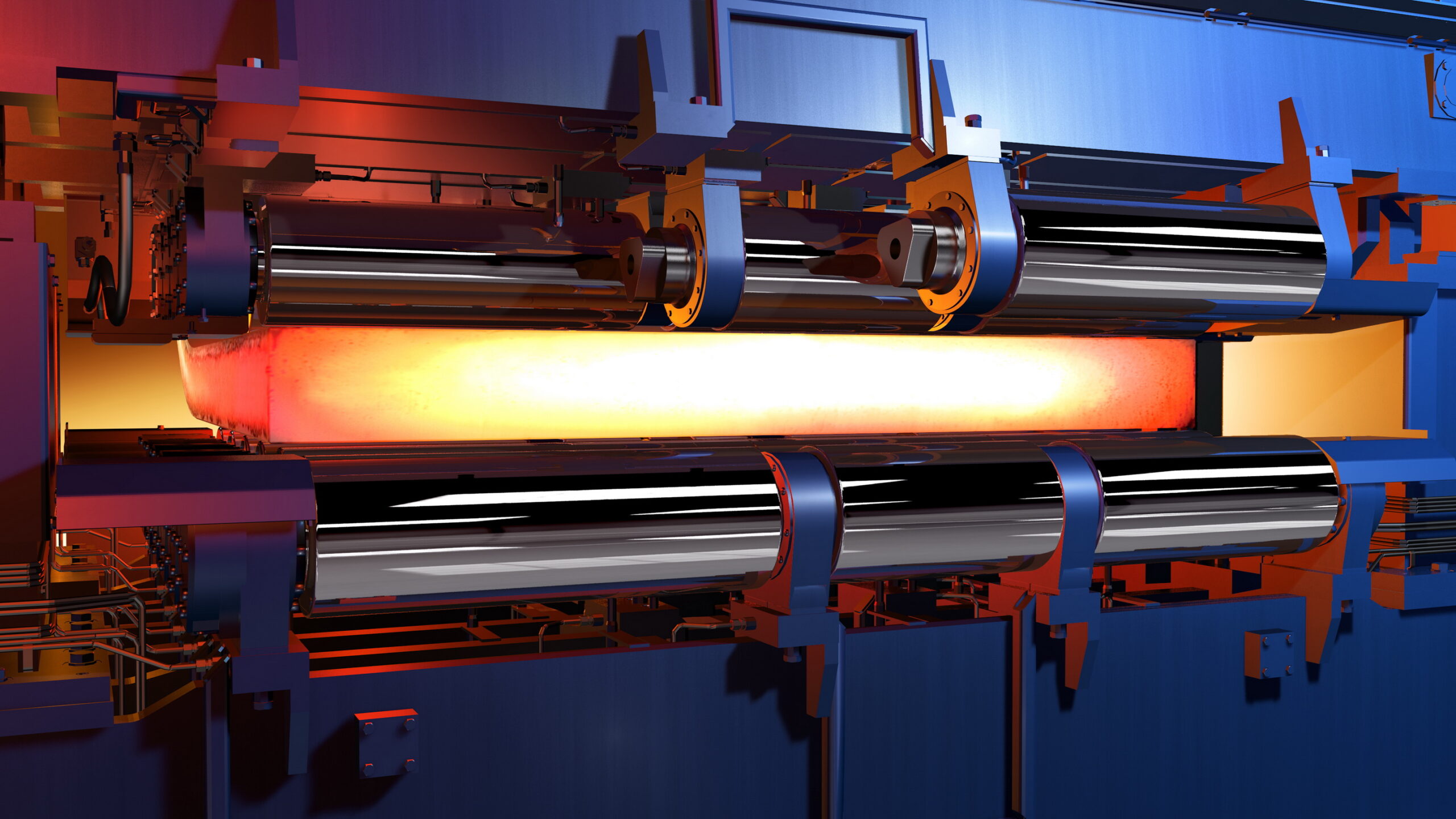
The continuous caster is to be completely rebuilt from the ladle turret to the exit section, and will be equipped with state-of-the-art continuous casting technology. A few steel structures and foundation areas will remain as they are. The new plant will be designed as a bow-type caster and offer a host of benefits, particularly for the casting of slabs which are made from crack-sensitive steel grades and are over 300 mm thick.
SMS group’s scope of supply comprises the basic and detail engineering, and the mechanical and electrical systems for the continuous caster. It also includes a ladle turret, adapted to the existing foundation and shop configuration, molds with hydraulic oscillation, strand guide with 25 segments, the relevant interchangeable parts, and the exit section. The supervision of the erection and commissioning is also part of the scope of supply.
The width range produced on the continuous caster is to be extended from a previous maximum of 2,200 to 2,800 mm, and the thickness range from 355 to 400 mm. The plant will be designed for an annual production capacity of max. 2 million t.
The plant will be equipped for twin casting, which is used for slab widths between 900 and 1,290 mm, and a maximum thickness of 250 mm.
The NLMK Group is one of Russia’s largest steel producers and is active in markets around the world.
(Source: SMS group)
NLMK commissions SMS to supply a thick slab caster
Kategorien: heat processing | Wirtschaft und Unternehmen
Autor: Redaktion
Datum: 17. Mai. 2018