Horizontal casting units have been part of Hertwich’s product range for 40 years. During that time the company has been able to accumulate comprehensive experience from numerous projects. That experience has contributed toward a continuous process of improvement, which has brought the company to a technological peak in this sector. In fact, the use of such plants is in no way limited to foundry alloys, as described below.
Trimet supplies foundry alloys optionally in the form of bi-part ingots of a belt-type ingot caster or as horizontal continuously cast ingots. For ingot production, in 2013 a belt-type ingot caster for 30,000 t/a went into operation. The existing horizontal continuous casting line with a capacity of 40,000 t/a, which has been in operation since 2003, has now been supplemented by a second line for 60,000 t/a. Thus, at the smelter casthouse in Essen horizontal continuous casting currently accounts for around a third of the production capacity. Both horizontal casting units and the belt-type ingot caster have been supplied by Hertwich.
Horizontally cast ingots are preferred as demanding input stock for direct processing. The market development shows, that aluminium for highly stressed castings, such as those used in particular by the automotive industry, is increasingly requested. In fact, Trimet confirms that the output of the new casting plant is destined for the automotive industry.
Important aspects are the economical plant operation and the quality of the products. The quality-relevant advantages of continuously cast alloys are: low contents of hydrogen and oxide as well as non-metallic inclusions, fine-grained and uniform microstructure, uniform distribution of the alloying elements, no segregation due to gravitational effects, free from cracks, cavities and inclusions, great uniformity in the dimensions, straightness and weight of sections cut from the strand and smooth surface, which simplifies stacking, strapping and also dispatch.
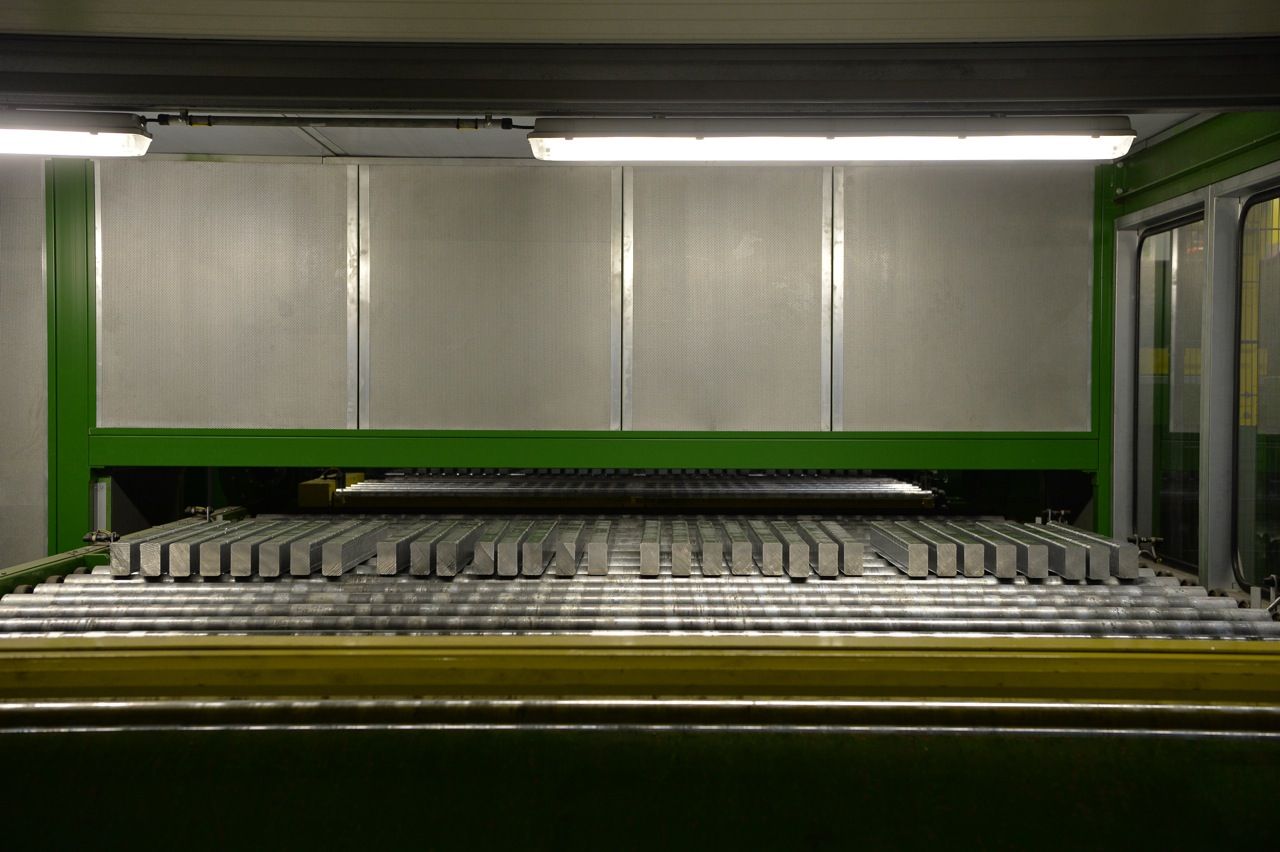
In consideration of economic aspects automation, output and availability of the plant play an important role. The horizontal continuous caster is designed for 32 strands of 90 mm x 54 mm. The height of the strands is different from the generally established standard dimension of 75 mm. The larger strand cross-section benefits a higher casting rate.
Stacking, marking, strapping and weighing are integrated in the automated process using well-proven standard components. For stacking, Hertwich uses an industrial robot which, on the one hand, has the necessary degrees of freedom of movement but which is, at the same time, also designed for high accelerations or decelerations.
Besides monitoring the operation, the control system is also responsible for managing the administrative data and for documenting all operating parameters. Each individual working step is checked by special monitoring and diagnosis programmes. In the event of deviations, the control system reacts immediately.
(Source: SMS group)
Trimet Essen orders horizontal continuous caster
Kategorien: heat processing | Wirtschaft und Unternehmen
Autor: Redaktion
Datum: 03. Nov. 2016